When I told her about the oats, Gilly said, Deborah Joy was a great believer in porridge.
This morning felt like autumn, and I made oatmeal for breakfast, what my Kiwi friends call porridge. I make porridge from steel cut oats.
Steel cut oats are different from rolled oats, which are what most people think of as oats. Rolled oats have the outer hull of the grain removed and are then steamed and flattened. Rolled oats can be eaten with no further cooking. Germans eat plain rolled oats with milk or yogurt, while Americans would typically cook them into fast hot cereal for breakfast, granola, or oatmeal raisin cookies. Steel cut oats on the other hand, are whole oats that have simply been sliced into pieces. A true whole food as, my parents would say, “sticks to your ribs.”
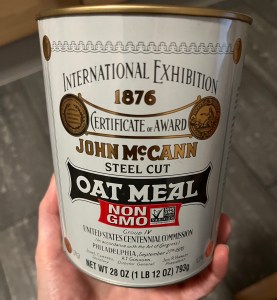
Growing up in my Irish-American family, we ate steel cut oats on weekends or holidays because in the 40 minutes or so they took to cook my mom could whip up a batch of griddle scones while we waited for dad to get back home with the New York Times. We bought them from the fancy food section of the department store in cans that looked like something from a different time.
I was an adult when they started to sell steel cut oats in bulk at the health food store. They were cheap, unlike the Irish ones in the can, so I started to eat them every day. I learned to make them by mixing the oats and water in a ratio of 1:2, bringing it to a boil, covering the pot, and leaving it overnight. In the morning breakfast just needs to be heated up. In California, when my son was small, we had steel cut oats with almond milk, maple syrup, and walnuts for breakfast every day.
When I was with Deborah Joy in July, it was winter in New Zealand. It was cold in the morning, I brought my cozy slippers and she gave me a gigantic fluffy dressing gown to wear. In the morning we padded around in our big robes and slippers, usually starting laughing right away even though it was always still dark when Deborah Joy emerged from her bedroom and we both knew that she was dying.
Deborah Joy was already sick enough that eating was a challenge. I cooked for her all week, and she joked that she had flown her private vegan chef in from Europe. One day she requested French toast for breakfast, but all other days it was porridge. She had hers with milk, maple syrup, and prunes, because nuts were by then too hard for her to digest.

Deborah Joy and I have a history with maple syrup. When we became friends, I would fly from New York to New Zealand with gallon metal cans of the best Vermont Fancy maple syrup which my parents would procure from the producers when they visited my dad’s best friend in New Hampshire. Consider the amount of friendship represented in these containers of tree sap. The overweight luggage was worth it to bring something so special across the globe, especially to her kids who enjoyed it as the delicacy it is.
The New Zealand steel cut oats I was preparing in July were a kind I had never had before: cut very small to be quick cooking. When Deborah Joy heard that I couldn’t get steel cut oats at all in Germany she insisted I take some home.
Our sole outing together was to the grocery store. While she only managed about half the store before becoming too exhausted, she was adamant about buying oats and large ziplock bags. She absolutely insisted I take four kilos, which was eight bags, and that I place two bags in each of four large ziplock bags, just in case any of the packages opened. She would not permit me to take less and watched attentively to make sure the packages went in the bags as she instructed.
I stuffed some of the oats in my suitcase along with several of her sweaters, a scarf I had given her when I moved from New Zealand in 2009, a winter hat with a koru pattern, and a stuffed toy for the Boy. The rest I put in her green backpack that had seen many airports, which she gave me with the tacit understanding that it become my new carry-on bag so she would be coming with me everywhere I went. Normally I would never take so many of my friend’s favorite things, but this was not a normal situation.
She knew she wouldn’t live another season. She knew she would never see me or the Boy again. She knew that things would be exactly as they are, so she made sure I had a suitcase almost overweight with oats. I wear her sweaters and make porridge for breakfast and the Boy and I talk about his godmother, my best friend, the one who said, “never leave a man behind” and “I dislike you all equally” and so many other unforgettable things. She was a great believer in porridge, as Gilly said, and she made sure that we would be abundantly nourished during these cold months, months which feel colder still with her gone.
 Tara Sullivan
Leave a comment